

When an allegation of family violence occurs in Texas, civil protective orders and criminal defense cases collide almost instantly. A protective order is not merely a piece of paper; it is a legally binding court injunction that fundamentally changes how a domestic assault lawyer handles an underlying criminal charge. Understanding how these orders impact criminal bond conditions, evidence gathering, trial strategy, and potential felony exposure is crucial for anyone facing charges in Fort Bend County.
Understanding the Interplay Between Civil Protective Orders and Criminal Domestic Assault
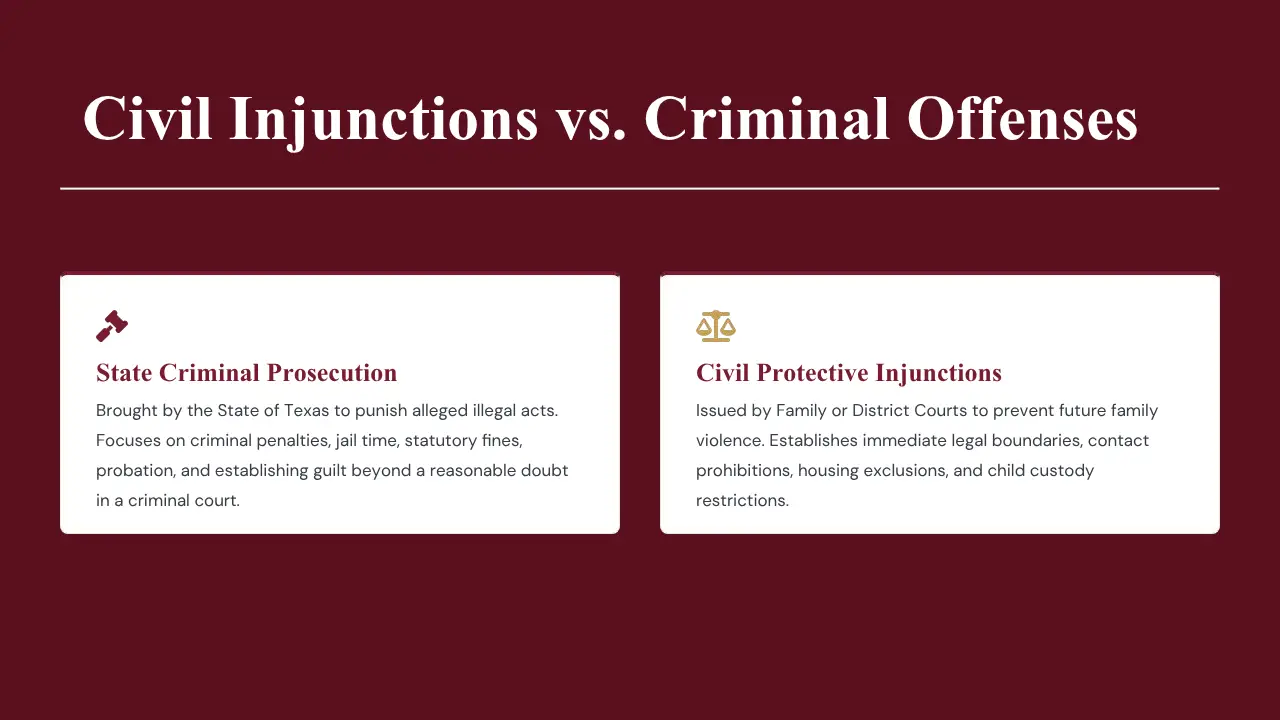
In Texas, a protective order is a court order issued to prevent family violence, sexual assault, or stalking. While a criminal assault case is brought by the State of Texas to punish alleged illegal conduct, a protective order is often handled in family court or a specialized court. However, the legal consequences of a protective order directly dictate the flow and severity of the pending criminal proceeding.
When a judge issues a Magistrate’s Order for Emergency Protection (MOEP) immediately after an arrest, or when a civil district court grants a temporary or final protective order, it establishes strict legal boundaries. If you are navigating these simultaneous legal proceedings, working with an experienced Domestic Assault Lawyer is essential to protect your rights, defend against wrongful allegations, and avoid compounding your legal troubles.
Immediate Consequences of a Protective Order on a Pending Criminal Case
A protective order alters the landscape of a criminal defense strategy from day one. Below are the primary ways these orders impact an active domestic assault charge in Texas courts:
1. Restricting Communication and Evidence Collection
Most protective orders include strict “no contact” directives prohibiting direct or indirect communication with the alleged victim. This restriction creates severe challenges for building a defense if you and your attorney need to gather facts, preserve text messages, or clarify events. Defense attorneys must conduct independent investigations through third-party witnesses and legal discovery rather than direct contact.
2. Imposing Automatic Firearm Disqualification
Under both Texas state law and federal law (18 U.S.C. § 922(g)(8)), an active family violence protective order prohibits the respondent from possessing firearms or ammunition. Unlawfully possessing a firearm while subject to a protective order can lead to immediate federal or state felony charges, regardless of the ultimate outcome of the underlying misdemeanor assault case.
3. Transforming Misdemeanor Offenses into Enhanced Felonies
Violating a protective order is a separate criminal offense under Texas Penal Code § 25.07. While a first-offense domestic assault without strangulation or prior convictions is typically charged as a Class A misdemeanor, violating the terms of a protective order can quickly result in state jail felony or third-degree felony charges. Prosecutors frequently use alleged order violations to increase bail amounts or push for harsher plea penalties.
“protective orders are designed to provide legal safety, but respondents have the statutory right to notice, a formal hearing, and legal representation to challenge unwarranted order conditions.” –Texas Courts
Can a Protective Order Be Dismissed in Texas?
A common question asked by individuals facing family violence charges is whether a protective order can be modified or dismissed before its scheduled expiration. The short answer is yes, but the process requires strict adherence to legal procedures.
Even if an alleged victim wishes to drop the protective order or reconcile, the order remains legally active until a judge formally signs an order modifying or vacating it. An individual who violates the order based on a verbal agreement with the applicant can still be arrested and prosecuted. A knowledgeable family violence protective order defense attorney can file formal motions to modify conditions or demonstrate to the court that the legal prerequisites for the order are no longer met.
Strategic Defense Approaches in Fort Bend County Courts
Handling a domestic violence case involving a protective order requires an integrated defense strategy that addresses both civil and criminal jurisdictions. Judges in Sugar Land, Richmond, and across Fort Bend County take allegations of domestic abuse seriously, making detailed preparation critical.
For example, testimony given during a civil protective order hearing can be transcribed and evaluated for inconsistencies that may be useful during the criminal trial. An adept domestic assault defense attorney utilizes cross-examination in civil hearings to expose gaps in the prosecution’s narrative before the criminal case reaches a jury.
How Emergency Protective Orders Differ from Final Protective Orders
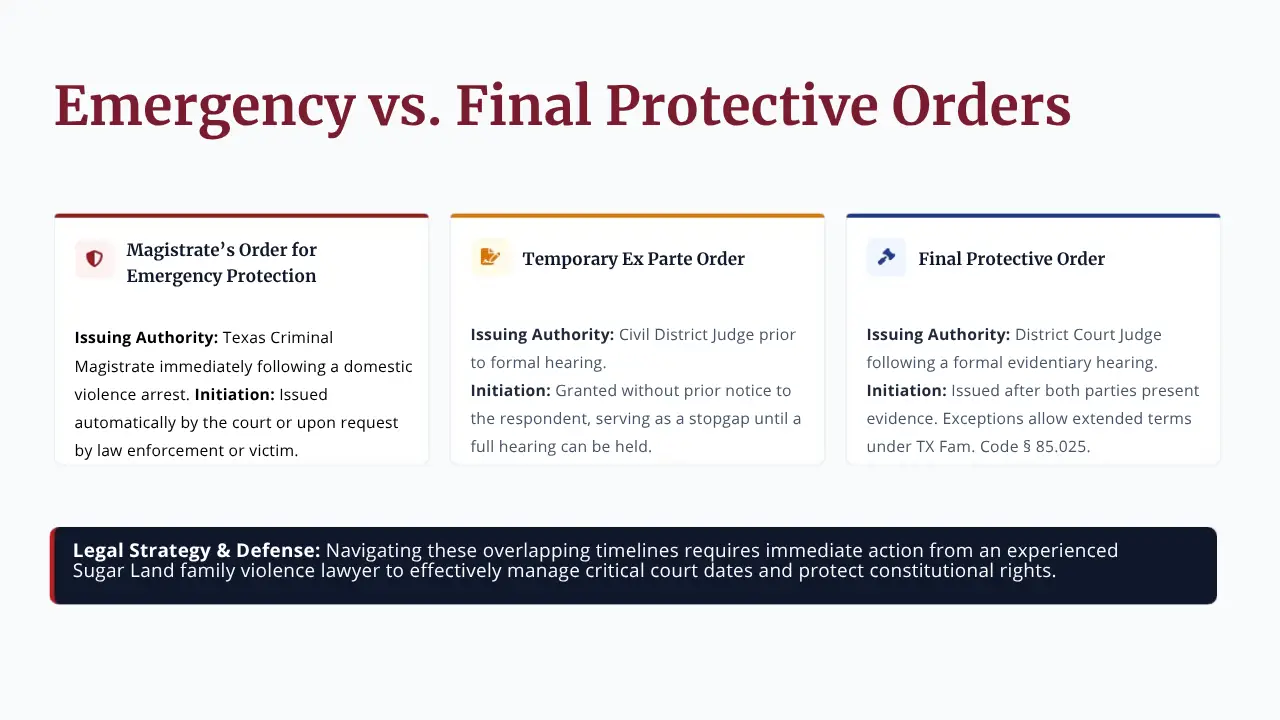
It is vital to distinguish between an emergency protective order Texas magistrates issue after an arrest and a full protective order issued after a district court hearing:
- Magistrate’s Order for Emergency Protection (MOEP): Issued automatically or at the request of police/victim immediately following a domestic violence arrest. Typically lasts 31 to 91 days.
- Temporary Ex Parte Order: Granted by a civil judge without prior notice to the respondent, remaining in effect for up to 20 days until a full hearing is held.
- Final Protective Order: Issued after a formal court hearing where both parties present evidence. Generally lasts up to two years, though certain exceptions allow longer durations under Texas Family Code § 85.025.
Navigating these overlapping timelines requires immediate action from a skilled family violence lawyer Sugar Land residents trust to manage court dates and protect constitutional rights.
Protecting Your Future with Experienced Defense Counsel
A protective order creates a complex web of legal restrictions that can permanently affect child custody, employment, housing, and personal liberty. Facing domestic assault charges alongside a protective order application requires decisive legal action from a dedicated David Hunter Law firm defense attorney who understands how local prosecutors and judges operate.
Domestic Violence Legal Impact Metric: According to data published by the Texas Department of Public Safety, Texas law enforcement agencies document over 200,000 incidents of family violence annually, leading to thousands of concurrent protective order applications and enhanced criminal prosecutions statewide.
Legal Disclaimer
The information provided is for educational and informational purposes only. The information on this website is not intended as legal advice and should not be used as a substitute for consulting a licensed attorney. Legal outcomes and laws can vary by jurisdiction, and only a qualified lawyer can provide guidance tailored to your situation.