

Many people assume that drug arrests in Texas only involve illicit street drugs like heroin, methamphetamine, or cocaine. However, state law strictly regulates prescription medications under the same statutory framework. Carrying medication prescribed to someone else, holding loose pills without a valid pharmacy container, or possessing standard pharmaceuticals without a legally binding prescription can lead to severe criminal charges.
Under Texas law, the unprescribed possession of medications such as oxycodone, hydrocodone, Xanax, or Adderall falls under the offense of possession of a controlled substance Texas. Whether the pills were given by a friend or purchased online, facing these allegations requires immediate representation from a skilled Drug Possession Lawyer who understands how local courts operate.
Understanding Prescription Drug Possession Laws in Texas
The Texas Controlled Substances Act (Texas Health and Safety Code Chapter 481) regulates both illicit substances and legal pharmaceutical medications. Controlled substances are categorized into penalty groups based on their potential for abuse and recognized medical utility.
To secure a conviction for prescription drug charges Texas prosecutors must prove two distinct elements beyond a reasonable doubt:
- Knowledge and Intent: You knowingly or intentionally possessed the substance.
- Lack of Legal Authorization: You did not have a valid, lawful prescription from a licensed healthcare provider at the time of possession.
A legitimate prescription serves as an affirmative defense under Texas law. However, carrying controlled substances outside their original labeled pharmacy container often leads to an initial arrest, forcing you to prove the legitimacy of your prescription in court.
How Texas Categorizes Unprescribed Prescription Drugs
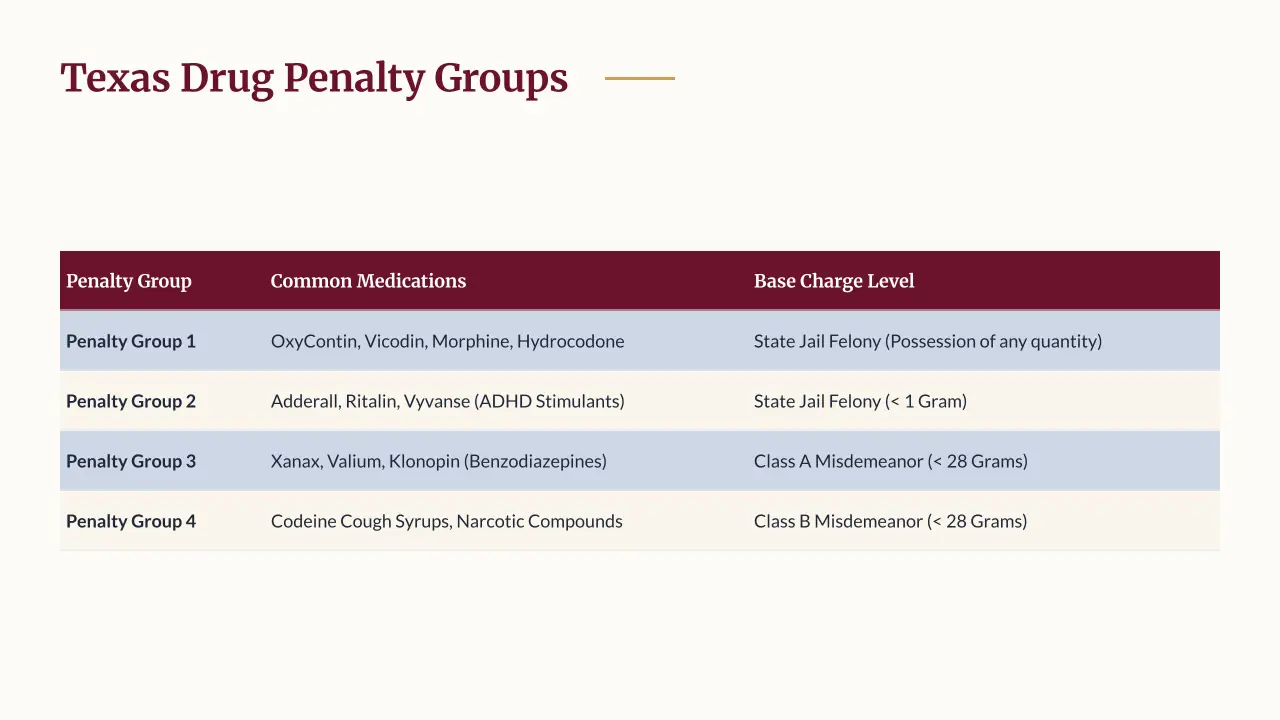
In Texas, prescription medications are divided among Penalty Groups 1, 2, 3, and 4. The potential criminal penalties depend heavily on the specific Penalty Group of the drug and the aggregate weight (including adulterants and dilutants) seized by law enforcement.
Common controlled prescription medications in Texas include:
- Penalty Group 1: Opioid painkillers such as OxyContin (oxycodone), Vicodin (hydrocodone), and morphine. Possession of any amount in Penalty Group 1 is charged as a felony.
- Penalty Group 2: Stimulants commonly prescribed for ADHD, including Adderall, Ritalin, and Vyvanse. Possession of under one gram is a state jail felony.
- Penalty Group 3: Depressants and anti-anxiety medications, including Xanax (alprazolam), Valium (diazepam), and Klonopin (clonazepam). Depending on quantity, charges range from a Class A misdemeanor to high-level felonies.
- Penalty Group 4: Prescription compounds containing lower doses of narcotics mixed with non-narcotic active ingredients, such as certain cough syrups containing codeine.
If you or a loved one is accused of having a controlled substance without prescription Texas law enforcement will classify the offense strictly by the total weight and schedule of the pills found.
According to the Centers for Disease Control and Prevention:
“Prescription medications, particularly opioids and benzodiazepines, are strictly regulated controlled substances because of their potent biological effects and high risk for physical dependence, misuse, and accidental toxicity.”
Common Scenarios Leading to Unlawful Prescription Possession Charges
Most individuals arrested for prescription drug offenses never intended to commit a crime. Common real-world scenarios that result in criminal charges include:
- Carrying loose pills: Transporting valid prescription medications in pill organizers, plastic bags, or glove compartments rather than the original pharmacy bottle.
- Borrowing medication: Accepting a single anti-anxiety pill or painkiller from a friend or family member for short-term relief.
- Outdated or expired prescriptions: Carrying medications prescribed years prior or after a doctor has formally revoked or changed the treatment plan.
- Constructive possession: Being a passenger in a vehicle where another person’s unprescribed medication is found in a shared space like the center console. In these situations, consulting a qualified constructive possession lawyer is essential for establishing lack of control or knowledge.
Can You Go to Jail for Prescription Drugs in Texas?
Yes, you can go to jail for possessing prescription drugs without a valid prescription in Texas. Penalties range from Class A misdemeanors (up to 1 year in county jail and fines up to $4,000) for small amounts of Penalty Group 3 or 4 drugs, to State Jail Felonies (180 days to 2 years in state jail) or First-Degree Felonies (up to 99 years in prison) for larger quantities of Penalty Group 1 or 2 medications like OxyContin or Adderall.
Frequently Asked Questions Regarding Prescription Drug Arrests
What if I have a valid prescription, but left the bottle at home?
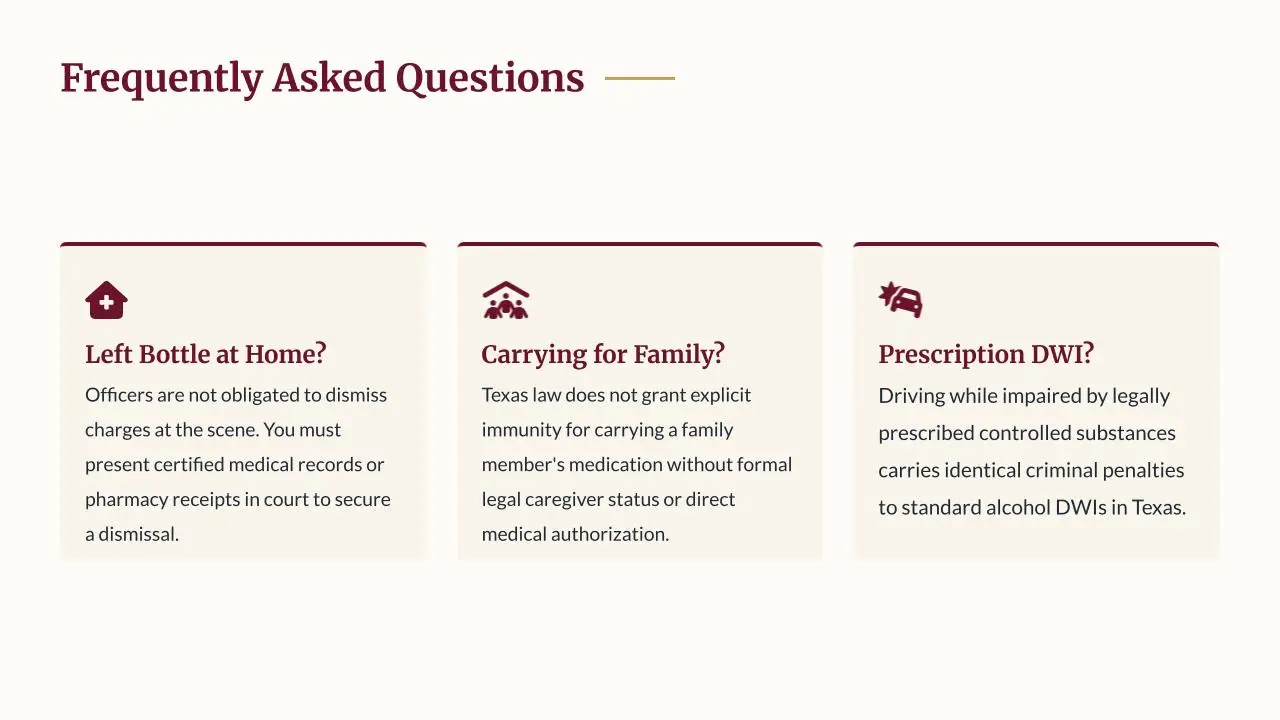
If you have a lawful prescription issued by a licensed provider, you have an affirmative defense under Texas Health and Safety Code § 481.123. However, police officers at the scene of a traffic stop or search are not required to dismiss charges based on your verbal statement. You must present certified medical records or pharmacy receipts in court to get the charges dismissed.
Can I carry my spouse’s or relative’s prescription medication for them?
Technically, Texas drug laws do not grant explicit immunity to family members carrying another person’s controlled substance unless they are recognized as a formal caregiver or acting directly under medical authorization. If stopped by law enforcement, holding someone else’s prescription bottle can lead to an arrest for prescription drug possession Texas until legal counsel intervenes.
What are the defenses against unprescribed drug charges?
An experienced defense strategy may involve proving:
- Unlawful search and seizure by law enforcement in violation of Fourth Amendment rights.
- Lack of knowing possession (you were unaware the pills were in your vehicle or property).
- A valid prescription or legitimate medical authorization existed at the time of arrest.
- Laboratory testing errors or improper chain of custody regarding the chemical composition of the seized pills.
Understanding your constitutional rights during traffic stops or police encounters is crucial; reviewing guidelines on your rights during a traffic stop can help protect your defense before charges are filed.
Why You Need an Experienced Defense Attorney in Fort Bend County
A conviction for prescription drug charges carries life-altering consequences beyond jail time and fines. A criminal record can impair your employment opportunities, professional licensing, background checks, and housing options. Furthermore, operating a motor vehicle while taking certain prescription medications can trigger additional charges under Texas driving laws; learning how courts handle a prescription DWI in Texas highlights how quickly simple possession can escalate into complex traffic offenses.
When facing charges in Richmond, Sugar Land, Missouri City, or surrounding areas, securing a local drug possession lawyer Fort Bend County residents trust ensures your case is handled with precision. Former judge and trial attorney David Hunter understands how prosecutors build drug cases and how to challenge illegal stops, search warrants, and chemical analysis reports to seek dropped or reduced charges.
If you are facing allegations of possessing a prescription drug without a prescription in Texas, contact the David Hunter Law Firm today to discuss your defense options.
Legal Disclaimer
The information provided is for educational and informational purposes only. The information on this website is not intended as legal advice and should not be used as a substitute for consulting a licensed attorney. Legal outcomes and laws can vary by jurisdiction, and only a qualified lawyer can provide guidance tailored to your situation.