

It is one of the most stressful scenarios imaginable: you are driving home or riding as a passenger when law enforcement pulls the vehicle over. During a search, officers discover illegal drugs hidden under a seat, inside the glove compartment, or tucked into a bag in the trunk. Even though the illicit substances belong to someone else, or were left behind in a shared vehicle, you find yourself handcuffed and facing serious criminal charges.
Many individuals assume that if a substance does not belong to them physically, police cannot legally charge them. Unfortunately, under Texas criminal law, officers frequently make arrests under these exact circumstances. Navigating these complex allegations requires a dedicated Drug Possession Lawyer who understands how to break down the prosecution’s case and protect your rights.
Understanding how Texas law views possession, what constitutes a shared space, and how prosecutors attempt to establish guilt can help you take immediate action to safeguard your future.
Understanding Actual vs. Constructive Possession in Texas
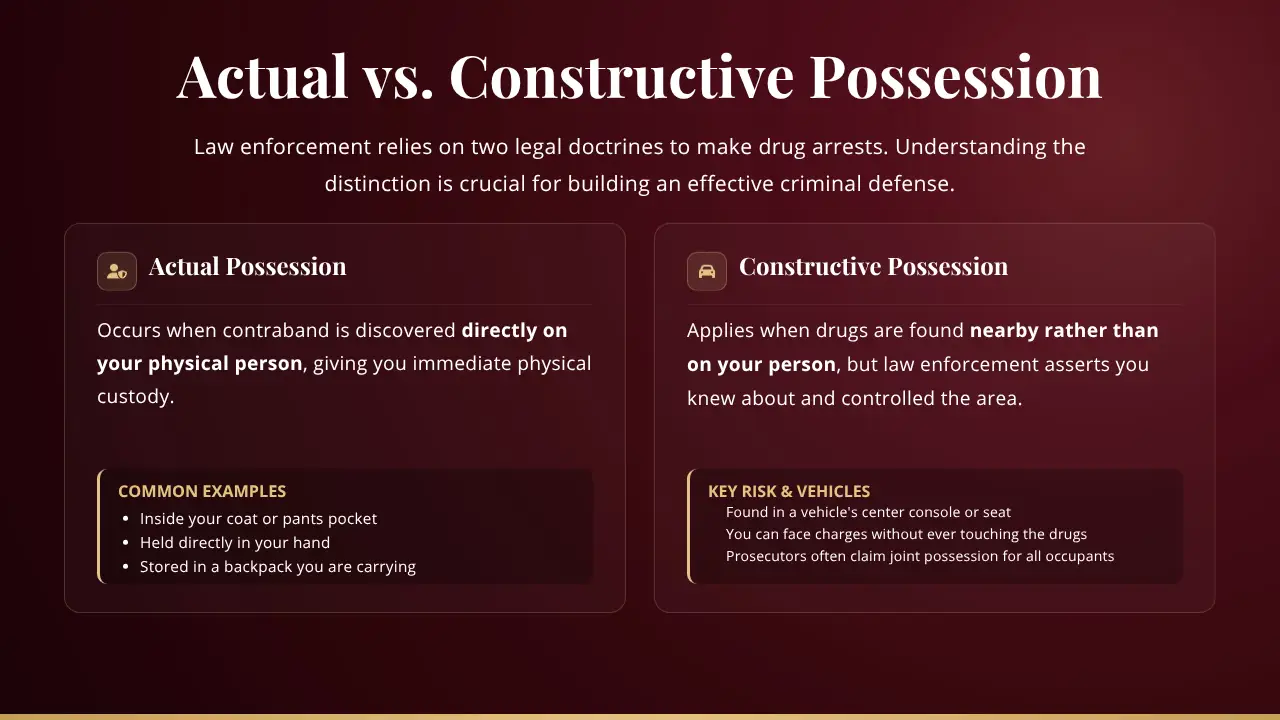
To secure a conviction for possession of a controlled substance, Texas prosecutors must prove two core elements beyond a reasonable doubt: that you exercised care, custody, control, or management over the illegal item, and that you knew the substance was contraband. In Texas, law enforcement relies on two legal doctrines to make drug arrests:
- Actual Possession: This occurs when contraband is discovered directly on your physical person, such as inside your coat pocket, held in your hand, or stored in a backpack you are carrying.
- Constructive Possession: This applies when illegal drugs are found nearby rather than on your person, but law enforcement asserts that you knew about the contraband and maintained control over the area where it was located.
The concept of constructive possession that Texas authorities enforce means you can face criminal charges even if you never physically touched or owned the drugs. For instance, if contraband is discovered in a center console or under a seat, prosecutors often claim that everyone inside the vehicle exercised joint constructive possession.
Drugs Found in My Car Texas: The Legal Reality of Shared Vehicles
One of the most frequent ways constructive possession charges arise is during traffic stops involving a shared vehicle drug possession scenario. Whether you borrowed a family member’s truck, rented a vehicle, or were driving friends around Sugar Land, discovering drugs found in my car Texas officers search can quickly turn a routine traffic stop into a felony arrest.
When police encounter drugs found in someone else’s vehicle or a car carrying multiple passengers, they rarely stop to conduct an in-depth investigation on the side of the road. If no single individual immediately takes responsibility for the contraband, officers frequently arrest every occupant in the car.
“To establish unlawful possession, the State must prove that the accused exercised care, control, or management over the contraband and knew the substance was illicit. Mere presence in the vicinity of a controlled substance is insufficient, on its own, to establish possession.”
Because mere proximity is not legal proof of guilt, the State cannot convict you simply because you were sitting near contraband. To bridge this gap, prosecutors must establish specific “affirmative links.”
How Prosecutors Attempt to Prove “Affirmative Links”
When multiple people have access to a vehicle or residence, Texas courts require prosecutors to present additional evidence connecting the accused to the illegal items. These circumstantial factors are legally known as affirmative links. A prosecutor may attempt to build a case against a passenger or driver using the following indicators:
- Visibility: Whether the controlled substance was in plain view of the occupants.
- Proximity and Accessibility: How close the drugs were to you and whether you could easily reach them.
- Ownership of the Space: Whether you owned, leased, or were driving the vehicle where items were found.
- Personal Belongings: Whether the drugs were found enclosed inside a bag containing your personal identification or possessions.
- Incriminating Statements or Demeanor: Nervous behavior, furtive movements, attempting to flee, or conflicting statements made to law enforcement during the traffic stop.
- Odors or Paraphernalia: Strong smells of contraband or visible drug paraphernalia inside the passenger cabin.
If the prosecution fails to establish sufficient affirmative links, a skilled possession of controlled substance lawyer can challenge the charges and demand a dismissal based on lack of evidence.
Key Defenses in Shared Space and Borrowed Vehicle Drug Cases
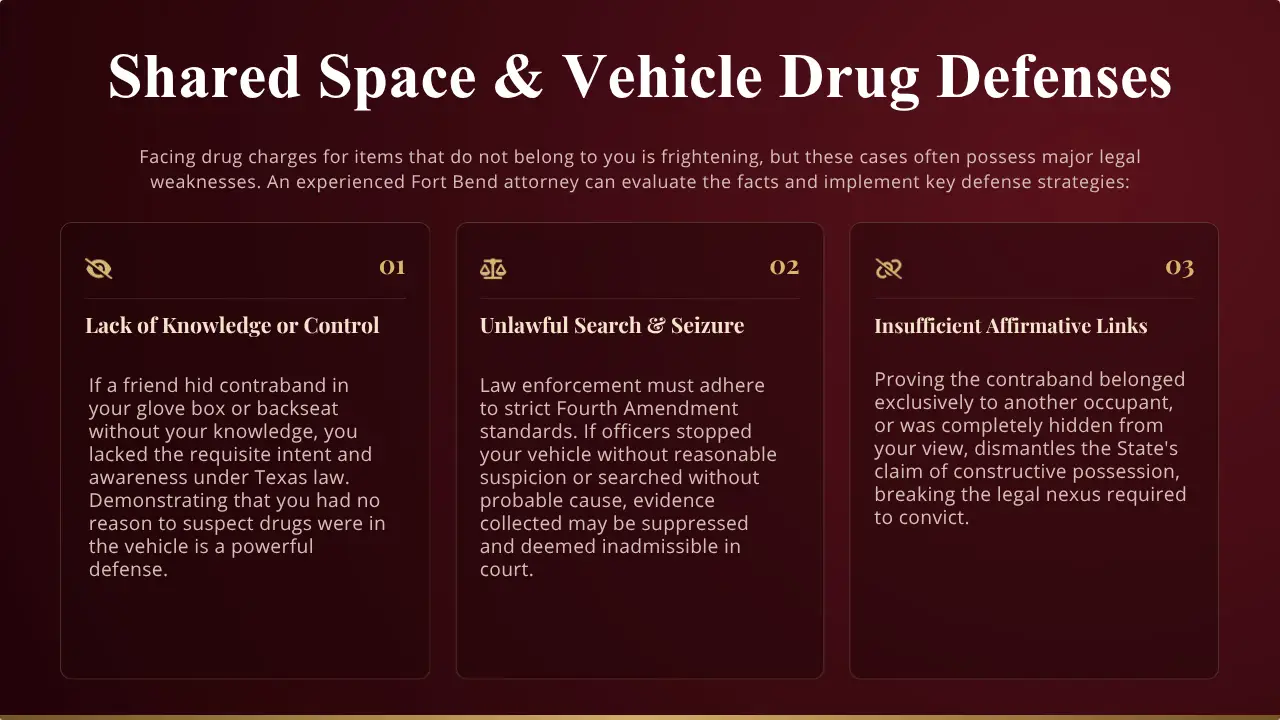
Facing drug charges for items that do not belong to you is frightening, but these cases often possess major legal weaknesses. An experienced Fort Bend drug possession attorney can evaluate the facts and implement tailored defense strategies, such as:
1. Lack of Knowledge or Control
If a friend hid contraband in your glove box or left a bag in your backseat without your knowledge, you lacked the requisite intent and awareness under Texas law. Demonstrating that you had no reason to suspect drugs were in the vehicle is a powerful defense.
2. Unlawful Search and Seizure
Law enforcement officers must follow strict Fourth Amendment constitutional standards. If officers pulled your vehicle over without reasonable suspicion, searched your cabin without probable cause or consent, or extended the traffic stop unlawfully, any evidence collected may be suppressed and deemed inadmissible in court.
3. Insufficient Affirmative Links
Showing that the contraband belonged exclusively to another occupant, or was completely hidden from your view, can dismantle the State’s claim of constructive possession.
Why You Need a Local Fort Bend County Criminal Defense Lawyer
Navigating drug allegations in Richmond, Sugar Land, or Missouri City requires immediate legal guidance. Drug possession penalties in Texas vary depending on the drug penalty group and quantity, ranging from Class B misdemeanors to severe first-degree felonies carrying long prison terms and hefty fines.
A trusted criminal defense lawyer expert in drug charges knows how local courts operate, how to challenge police procedures, and how to negotiate effectively with prosecutors. Having a seasoned trial attorney on your side ensures your rights are protected at every stage of the legal process.
Protect Your Future with the David Hunter Law Firm
If you or a loved one were arrested after police found drugs in a shared car or home, do not attempt to handle law enforcement questions alone. Anything you say can be used by prosecutors to attempt to establish affirmative links against you.
Enlisting a proven defense strategy tailored to Texas possession of controlled substance defense guidelines can make all the difference between a life-altering conviction and a case dismissal. Contact the David Hunter Law Firm today to discuss your case and begin building a strong legal defense.
Legal Disclaimer
The information provided is for educational and informational purposes only. The information on this website is not intended as legal advice and should not be used as a substitute for consulting a licensed attorney. Legal outcomes and laws can vary by jurisdiction, and only a qualified lawyer can provide guidance tailored to your situation.