

When an argument in a home escalates, law enforcement officers called to the scene often make rapid decisions under intense pressure. In Texas, officers responding to domestic disturbance calls frequently make an arrest to diffuse the situation, regardless of who started the confrontation. If you were forced to protect yourself or your children during a physical altercation, finding yourself in handcuffs can feel like a complete betrayal of justice. However, under Texas law, taking defensive action does not automatically make you a criminal.
If you are facing allegations of family violence, hiring a skilled Domestic Assault lawyer is essential to protecting your rights, reputation, and freedom. Understanding how Texas law evaluates claims of self-defense can make all the difference in building an effective legal strategy for your case.
Understanding Texas Law on Self-Defense Against Domestic Assault Charges
In Texas, self-defense is an affirmative defense recognized under Section 9.31 of the Texas Penal Code. The statute establishes that a person is justified in using force against another when and to the degree they reasonably believe force is immediately necessary to protect themselves against the other’s use or attempt to use unlawful force.
When asserting self-defense against domestic assault charges, your defense attorney must establish key legal elements:
- Imminent Threat: The threat of physical harm must be immediate, not a threat of potential harm in the future.
- Reasonable Belief: A reasonable person in the same situation would have believed that physical force was necessary to prevent harm.
- Proportional Force: The force used to defend yourself must be proportionate to the force used or threatened against you. For instance, using deadly force in response to a minor push generally does not satisfy proportional legal standards.
- Lack of Provocation: You did not provoke the person who threatened or attacked you.
Because domestic assault allegations often involve conflicting statements from two parties without third-party witnesses, establishing these facts requires careful investigation and evidence gather by an experienced legal team.
Why Victims Are Sometimes Arrested for Family Violence Self-Defense in Texas

It is surprisingly common for individuals who act strictly in self-defense to be arrested for domestic assault in Texas. Law enforcement officers are trained to evaluate visible physical injuries, scene conditions, and statements from both parties. However, these quick evaluations do not always reflect who was the primary aggressor.
Factors that often lead to the wrongful arrest of someone acting in self-defense include:
- Visible Injuries on the Initial Aggressor: If you defended yourself and left marks or scratches on your attacker while trying to escape, officers might view those marks as evidence that you were the physical aggressor.
- Calm Demeanor vs. Emotional Distress: Primary aggressors are sometimes composed when police arrive, while the person defending themselves may appear agitated, distressed, or angry due to trauma, leading officers to draw incorrect conclusions.
- Lack of Immediate Defensive Marks: Defensive wounds, such as bruises under the arms or on the inner forearms, can take hours to fully surface after an altercation.
According to the legal resources at Cornell Law School’s Legal Information Institute:
Self-defense is the use of force to protect oneself from an attempted injury by another. To successfully claim self-defense, the defendant must generally show a threat of imminent unlawful force, a real fear of harm, and that the force used was reasonable under the circumstances.
A qualified attorney can re-examine physical evidence, phone records, and witness testimony to demonstrate that your actions were entirely defensive.
Key Defenses in Family Violence Cases Beyond Self-Defense
While self-defense is a powerful argument, a strong defense strategy will often evaluate additional legal avenues based on the facts surrounding your arrest.
Defense of Others
Under Texas Penal Code Section 9.33, you are legally justified in using physical force to protect a third party—such as a child, relative, or bystander—if you reasonably believe that person is in immediate danger of unlawful violence. If you intervened during a domestic incident to shield your child from harm, defense of others serves as a full legal defense against domestic assault charges.
Lack of Intent or Accidental Harm
Under Texas law, assault requires proof that an individual acted intentionally, knowingly, or recklessly. If physical contact occurred purely by accident during a heated disagreement—such as accidentally striking someone while reaching for a door handle to leave—the prosecution cannot satisfy the statutory requirements for assault.
False Accusations and Fabricated Claims
Domestic violence allegations frequently surface during tense family law proceedings, such as divorce or child custody disputes. In some situations, an accuser fabricates or exaggerates claims to gain leverage in court, obtain exclusive access to a shared home, or secure favorable custody arrangements. Uncovering inconsistencies in the accuser’s narrative is critical to dismantling false claims.
Why You Need a Domestic Assault Lawyer in Fort Bend County
Navigating the criminal justice system in Fort Bend County requires a defense strategy tailored to local court procedures and prosecution practices. Domestic assault cases carry unique challenges, including automatic emergency protective orders (magistrate’s orders for protection) that can immediately bar you from your home and restrict contact with your children.
An experienced domestic assault lawyer Fort Bend County residents trust will act quickly to:
- Challenge Protective Orders: Work to modify restrictive orders so you can regain contact with your loved ones and return to your residence when legally appropriate.
- Preserve Vital Evidence: Secure electronic evidence, including text messages, voicemails, 911 audio recordings, home security footage, and medical records before they are overwritten or destroyed.
- Engage with Prosecutors Early: Present self-defense evidence directly to the Fort Bend County District Attorney’s Office before formal charges are filed, aiming for a charge reduction or complete dismissal.
- Prepare a Compelling Trial Strategy: If prosecutors refuse to drop the charges, present a clear, evidence-backed narrative to a jury demonstrating that your actions were legally justified.
What to Do Immediately After Being Arrested for Domestic Assault
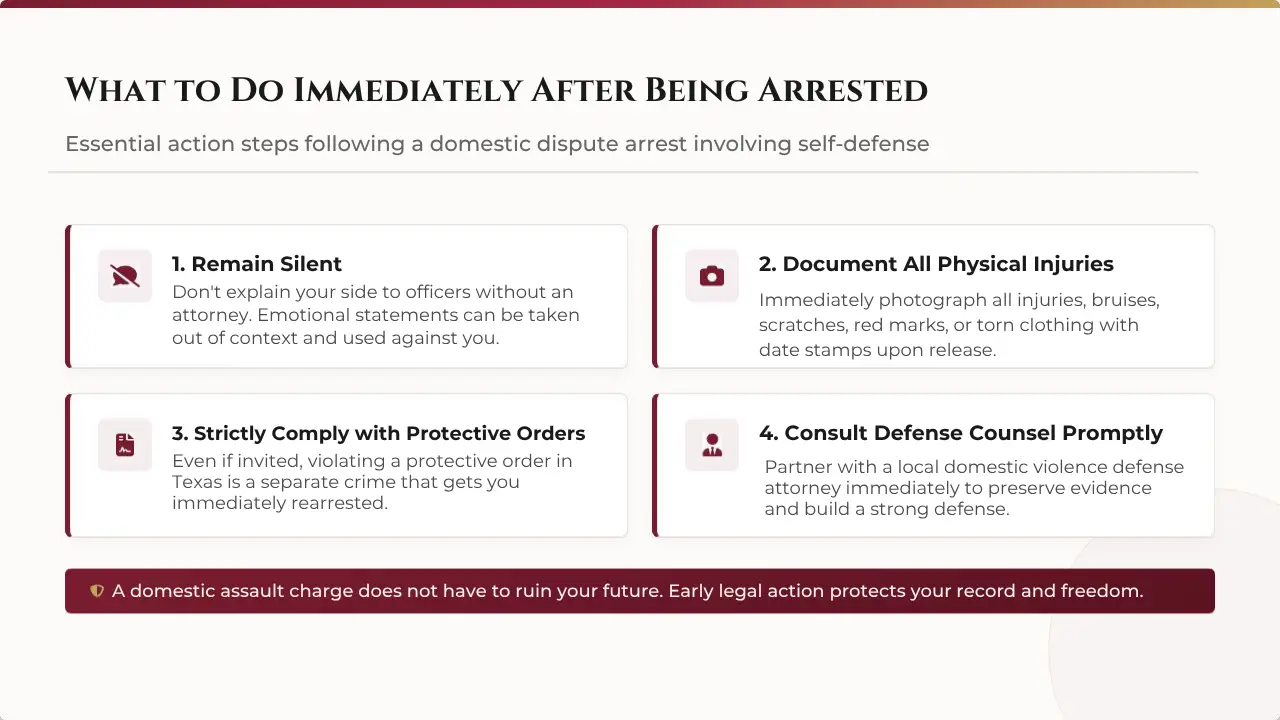
If you have been arrested following a domestic dispute where you acted in self-defense, the actions you take immediately following your release are critical to your defense:
- Exercise Your Right to Remain Silent: Do not attempt to explain your side of the story to law enforcement officers without an attorney present. Statements made in emotional distress can be used against you out of context.
- Document All Physical Injuries: Take clear, dated photographs of any injuries you sustained during the incident, including minor bruises, scratches, red marks, or torn clothing.
- Comply Strict with Protective Orders: Even if your accuser attempts to contact you or invites you back home, violating a protective order is a separate criminal offense in Texas that can lead to immediate rearrest.
- Consult a Defense Attorney Promptly: Contact a domestic violence defense attorney who understands local court processes and can start building your defense immediately.
A domestic assault charge does not have to ruin your future. With proper legal representation, self-defense claims can successfully protect your record and your freedom.
To learn more about your legal options or schedule a consultation regarding your case, contact the David Hunter Law firm.
Domestic Violence Data Insight: According to reports from the Texas Council on Family Violence, law enforcement agencies across Texas documented 254,339 family violence offenses in a single year, highlighting how frequently domestic disputes require formal legal intervention and thorough judicial review.
Legal Disclaimer
The information provided is for educational and informational purposes only. The information on this website is not intended as legal advice and should not be used as a substitute for consulting a licensed attorney. Legal outcomes and laws can vary by jurisdiction, and only a qualified lawyer can provide guidance tailored to your situation.