

Facing a law enforcement inquiry can be an overwhelming experience. When a routine traffic stop or unexpected encounter turns into a narcotics inquiry, knowing your legal boundaries is critical. Texas enforces aggressive controlled substance laws, and local law enforcement officers frequently leverage a driver’s or pedestrian’s compliance to build an incriminating file. Understanding your constitutional protections can completely alter the outcome of your case.
If you or a loved one is being targeted by law enforcement, consulting a qualified Drug Possession Lawyer immediately is the most reliable way to insulate yourself from prosecutorial overreach. Below, we break down exactly how your constitutional safeguards operate in the real world and how you can exercise them safely.
The Critical Importance of Your Right to Remain Silent in Texas

One of the most heavily relied upon tactics by investigators is continuous police questioning regarding drug possession. Officers may utilize casual questioning to establish dynamic probable cause or secure a verbal admission before an actual arrest takes place. They may ask questions like, “Where are you coming from?” or “Is there anything in this vehicle I should know about?”
Your absolute shield against this strategy is your right to remain silent in Texas. Protected under the Fifth Amendment of the United States Constitution, this safeguard establishes that you are under no legal obligation to answer substantive, incriminating questions from law enforcement authorities.
To safely exercise this protection, you must speak up and explicitly state your choice. Simply remaining quiet can sometimes be interpreted ambiguously by the courts. You can say: “I am invoking my right to remain silent, and I want to speak with a lawyer before answering any questions.” Once you state this clearly, it is crucial that you stop talking entirely. Continued conversation can accidentally waive your protection and supply the state with statements they can use against you in court.
“The Fifth Amendment provides that no person “shall be compelled in any criminal case to be a witness against himself,” establishing the foundational legal framework for an individual’s right to refuse interrogation during a criminal investigation.” – Cornell Law School Legal Information Institute,
Navigating Search and Seizure Rights in Texas During Traffic Stops
A significant percentage of controlled substance arrests stem from roadside vehicle checks. Understanding your fundamental search and seizure rights in Texas under the Fourth Amendment can help prevent law enforcement from accessing unlawfully gathered evidence.
During a traffic stop, police officers are legally restricted in their actions:
- The Scope of the Stop: Law enforcement cannot unreasonably prolong a routine stop just to wait for a drug sniffing K9 unit to arrive without external probable cause.
- Consensual Searches: Officers often ask, “Do you mind if I take a quick look inside your trunk?” This is a direct request for consent. You have the absolute right to say no. Refusing a voluntary search is not an admission of guilt; it is simply enforcing your constitutional boundaries.
- Plain View Doctrine: If illicit substances or clear contraband are clearly visible from outside the vehicle window, officers are legally permitted to seize the items and conduct a comprehensive search without a warrant.
If an officer proceeds to conduct a search despite your explicit refusal, do not physically resist or argue on the side of the road. State clearly that you do not consent to the search, observe their actions closely, and let your defense counsel challenge the legality of their conduct in a suppression hearing later.
Your Essential Rights After a Drug Arrest in Texas
If an investigation transitions into a formal custodial arrest, the choices you make in the immediate aftermath will directly affect your defense options. Your rights after a drug arrest in Texas are meant to secure your legal position, but they only work if you actively invoke them.
Upon being taken into custody, you must be informed of your Miranda warnings before any interrogation can legally occur. This includes your right to stop answering questions at any point and your right to have legal representation present during all questioning. If officers continue to question you after you have requested an attorney, any statements they extract may be deemed inadmissible by a judge.
Securing a dedicated possession of controlled substance lawyer as early as possible ensures that a professional can step between you and the state’s prosecutors, protecting you from tactical missteps and ensuring your side of the story is properly preserved.
Why You Need a Local Drug Possession Lawyer in Fort Bend County
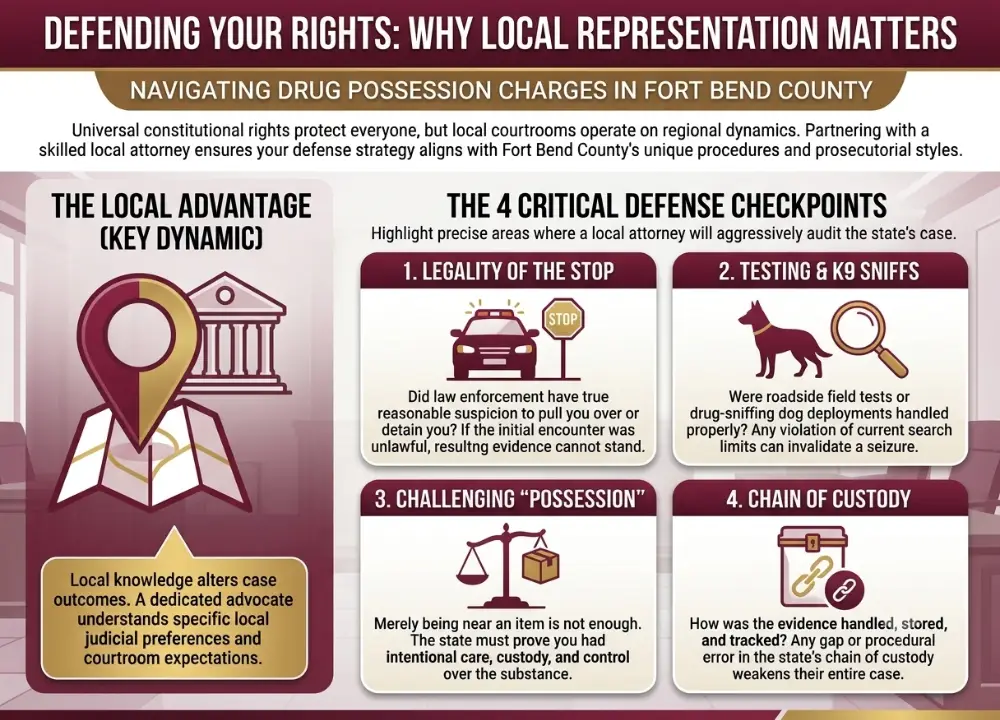
While federal and state constitutions set down universal baselines, the local court systems operate with unique regional dynamics. Partnering with a skilled drug possession lawyer in Fort Bend County ensures your defense strategy aligns with local courtroom procedures, specific prosecutorial approaches, and local judicial preferences.
A knowledgeable local defense attorney will immediately scrutinize the state’s case for procedural errors, including:
- Determining whether the original traffic stop or police encounter lacked reasonable suspicion.
- Evaluating whether field-testing procedures or drug-sniffing dog deployments violated current search parameters.
- Challenging the legal definition of “possession,” which requires the state to prove you had intentional care, custody, and control over the substance.
- Investigating potential problems with the state’s chain of custody for the seized evidence.
Do not navigate the complexities of the Texas criminal justice system on your own. Retaining an experienced advocate allows you to aggressively challenge the state’s evidence while building a proactive strategy aimed at getting your charges reduced or completely dismissed.
To learn more about building a robust defense against state narcotics allegations or to schedule a confidential review of your case, reach out to the David Hunter Law firm today.
Texas Legal Case Fact: According to the Annual Statistical Report for the Texas Judiciary, new misdemeanor drug possession cases filed across the state have declined over multiple consecutive years, falling to their lowest reported levels since 1993 as case priorities continue to shift. Source: Texas Courts Judicial Directory Reports.
Legal Disclaimer
The information provided is for educational and informational purposes only. The information on this website is not intended as legal advice and should not be used as a substitute for consulting a licensed attorney. Legal outcomes and laws can vary by jurisdiction, and only a qualified lawyer can provide guidance tailored to your situation.