


In Texas, a victim cannot directly drop domestic violence charges. Once police receive a call or report, the decision to file, pursue, or dismiss criminal charges lies solely with the State of Texas and local prosecutors (such as the Fort Bend County District Attorney’s Office). Even if an alleged victim signs an Affidavit of Non-Prosecution, prosecutors can choose to proceed with trial if they believe sufficient evidence exists.
Charged in Fort Bend County? Talk to a former Fort Bend County judge and prosecutor. I only handle cases in Fort Bend County courts. Call (281) 265-1515 or read about my Fort Bend County domestic violence defense.
Each year, millions of Americans experience domestic disputes that result in emergency police intervention. When officers respond to a domestic distress call in Fort Bend County or anywhere across Texas, the situation escalates into a formal criminal investigation almost instantly. Victims, spouses, and family members are frequently surprised to discover that they do not possess the legal authority to drop family violence charges once law enforcement officers get involved.
Understanding how the criminal justice system processes domestic assault accusations, what procedural options exist for both victims and defendants, and how an experienced Domestic Assault Lawyer can protect your legal rights and future is essential for navigating court proceedings effectively.
Who Has the Authority to Drop Domestic Violence Charges in Texas?
Contrary to a widespread legal myth, domestic violence charges are not filed by the victim. In Texas, criminal charges are brought by the State of Texas against the accused individual.
When a domestic disturbance is reported in Sugar Land, Richmond, Rosenberg, or surrounding Fort Bend County communities, law enforcement agencies follow strict operational protocols:
- Investigation & Arrest: Responding officers collect physical evidence, interview involved parties, take witness statements, evaluate visible bodily injuries, and make an arrest if probable cause indicates family violence occurred.
- Review by Prosecutors: Police reports, body-camera recordings, 911 call audio, and officer statements are submitted directly to the district attorney’s office for a formal legal review.
- State Prosecution Decision: The local prosecutor evaluates the strength of the evidence to determine whether to formally file charges, negotiate a plea agreement, reduce the severity of the offense, or dismiss the case entirely.
Because domestic assault is classified as a crime against the State of Texas rather than an individual civil matter, only the prosecutor or a presiding judge holds the legal authority to drop or dismiss charges.
Why Victims Often Seek to Drop Domestic Violence Charges
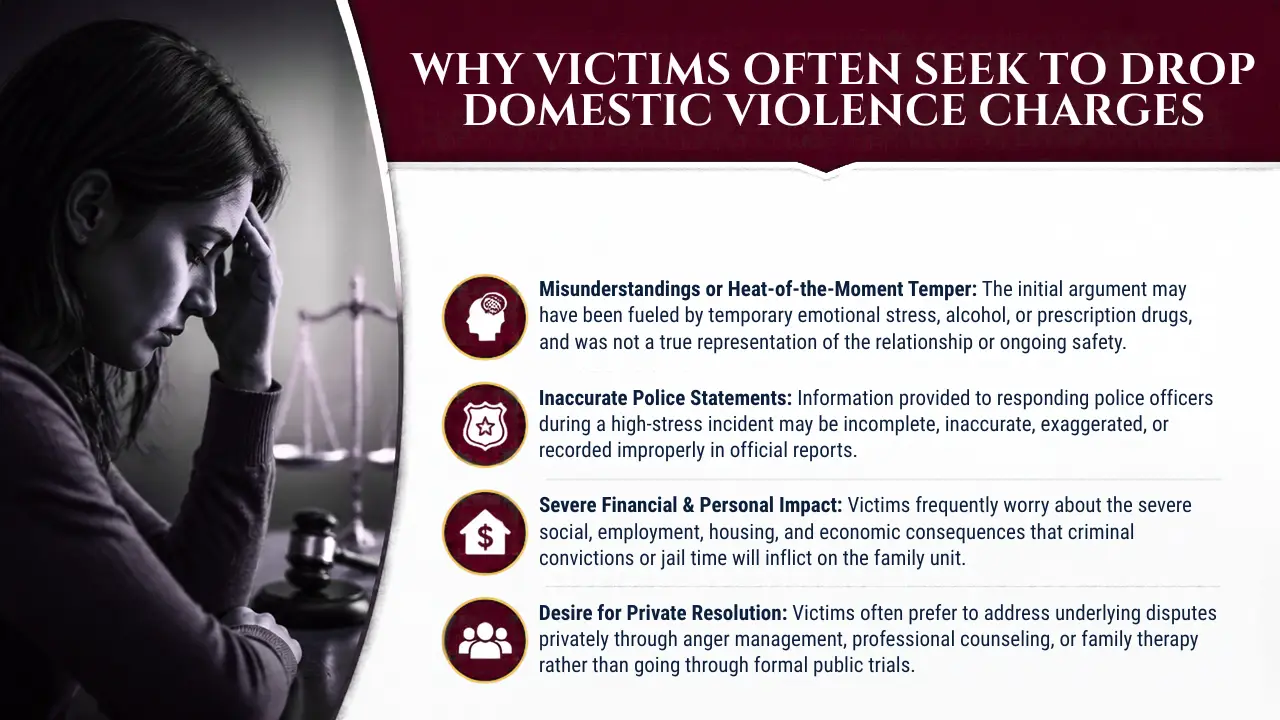
There are several understandable reasons why victims or complaining witnesses may wish to halt criminal proceedings against a partner or family member:
- Misunderstandings or Heat-of-the-Moment Tempers: The initial argument may have been fueled by temporary emotional stress, alcohol, or prescription drugs, and was not a true representation of the relationship or ongoing safety.
- Inaccurate Police Statements: Information provided to responding police officers during a high-stress incident may be incomplete, inaccurate, exaggerated, or recorded improperly in official reports.
- Severe Financial & Personal Impact: Victims frequently worry about the severe social, employment, housing, and economic consequences that criminal convictions or jail time will inflict on the family unit.
- Desire for Private Resolution: Victims often prefer to address underlying disputes privately through anger management, professional counseling, or family therapy rather than going through formal public trials.
“In domestic violence prosecutions, law enforcement and prosecutors treat the state as the injured party, meaning victim preferences are considered but are not legally binding on the court’s decision to proceed.”
Frequently Asked Questions About Texas Domestic Assault Cases
Can a victim recant or sign an Affidavit of Non-Prosecution?
Yes, a victim has the legal right to sign an Affidavit of Non-Prosecution expressing a clear desire not to testify, participate in court, or pursue criminal penalties against the defendant. However, this affidavit is not legally binding on the state. Prosecutors regularly move forward with domestic violence prosecutions using independent secondary evidence, such as 911 audio recordings, officer bodycam footage, crime scene photographs, and medical records.
What are the legal consequences of domestic violence charges in Texas?
Domestic violence penalties vary significantly based on offense history and the specific allegations involved. First-offense Class A misdemeanors carry penalties of up to one year in county jail and fines up to $4,000. Felony family violence charges carry state prison sentences, mandatory batterers’ intervention programs, protective restraining orders, and the permanent loss of firearm rights. Furthermore, a domestic violence conviction cannot be expunged from a criminal record in Texas.
Why do prosecutors pursue family violence cases when victims object?
State legislative policies prioritize public safety and aim to eliminate potential coercion, intimidation, or fear of retaliation in domestic situations. As a result, prosecutors examine all available physical and testimonial evidence independently of the victim’s current preferences.
Why Contacting a Defense Attorney Is Critical
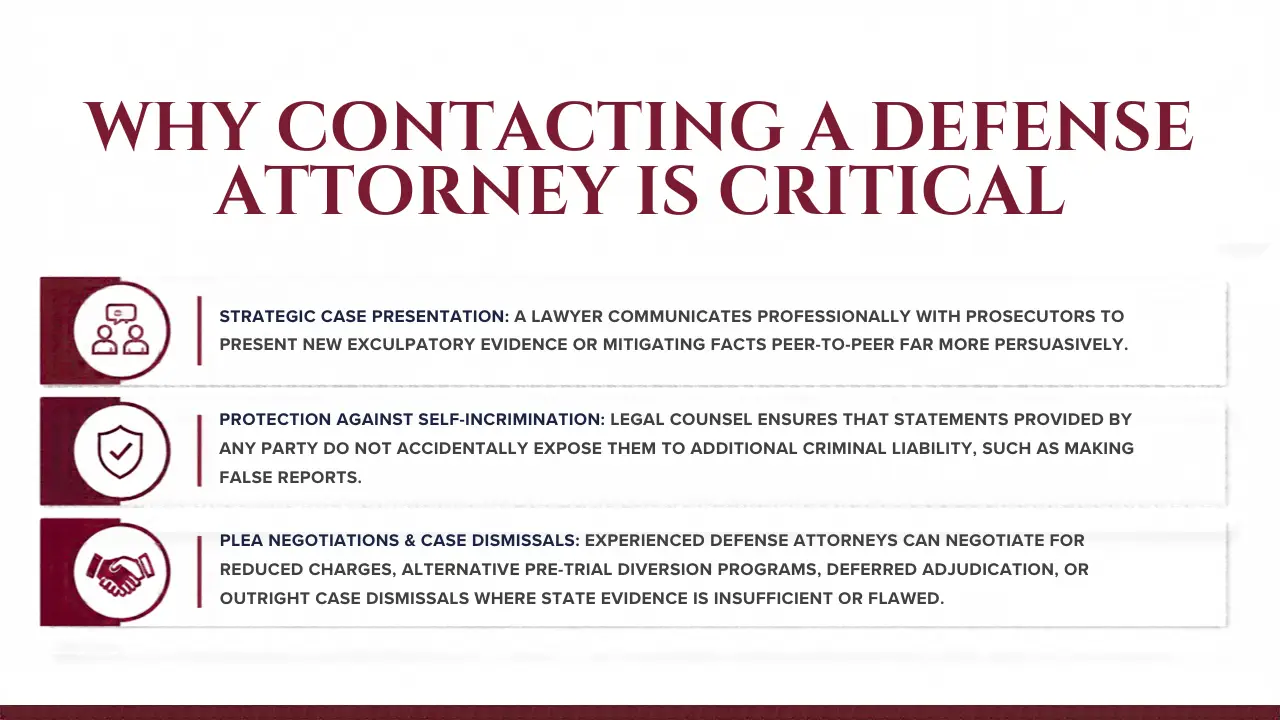
Attempting to influence a prosecution decision without professional legal representation can introduce significant risks, including potential self-incrimination, obstruction claims, or additional legal complications for everyone involved. Working alongside a skilled criminal defense lawyer provides critical advantages:
- Strategic Case Presentation: A lawyer communicates professionally with prosecutors to present new exculpatory evidence or mitigating facts peer-to-peer far more persuasively.
- Protection Against Self-Incrimination: Legal counsel ensures that statements provided by any party do not accidentally expose them to additional criminal liability, such as making false reports.
- Plea Negotiations & Case Dismissals: Experienced defense attorneys can negotiate for reduced charges, alternative pre-trial diversion programs, deferred adjudication, or outright case dismissals where state evidence is insufficient or flawed.
Navigating the Texas criminal justice system requires strategic guidance from a professional domestic violence attorney in Fort Bend County who understands local prosecution strategies and court processes.
Key Statistic: According to the National Coalition Against Domestic Violence, 1 in 3 women and 1 in 4 men in the United States have experienced some form of physical violence by an intimate partner during their lifetime.
Legal Disclaimer
The information provided is for educational and informational purposes only. The information on this website is not intended as legal advice and should not be used as a substitute for consulting a licensed attorney. Legal outcomes and laws can vary by jurisdiction, and only a qualified lawyer can provide guidance tailored to your situation.
Charged in Fort Bend County? Talk to a former Fort Bend County judge and prosecutor. I only handle cases in Fort Bend County courts. Call (281) 265-1515 or read about my Fort Bend County domestic violence defense.